Schema Normalization
Schema normalization ensures data integrity by organizing tables to minimize redundancy and prevent update anomalies. DataJoint's workflow-centric approach makes normalization intuitive.
Three lenses on normalization
Normalization is not a single algorithm but a family of design principles that all point toward the same goal: store each fact once, make integrity enforceable, and keep the schema easy to query and reason about. Three traditions arrived at these principles from different starting points, and it is worth holding all three in view, because each illuminates a different facet of the same design.
| Lens | One-line rule |
|---|---|
| Codd (mathematical) | Every non-key attribute depends on the key, the whole key, and nothing but the key. |
| Chen (entity) | Each table represents one entity type, and every attribute describes that entity. |
| DataJoint (workflow) | Each table represents one workflow step, and foreign keys prescribe the order of operations. |
The remarkable fact is that these three lenses converge on the same schema. Codd reasons abstractly about functional dependencies; Chen reasons concretely about the entities in a domain; DataJoint reasons operationally about when each entity comes into being. Faced with the same tangled table, all three prescribe the same decomposition. They differ only in the reasoning that gets you there — and in strictness: the workflow lens is the tightest of the three, as the e-commerce example below shows.
The mathematical lens: classical normal forms
Edgar Codd's normal forms, developed in the early 1970s, ground normalization in
functional dependencies. An attribute A functionally determines B
(written A → B) when a value of A fixes a single value of B — for example
mouse_id → date_of_birth, or (student, course) → grade. Normalization asks
which of these dependencies belong together in one table and which signal that a
table is doing too much.
The classical progression addresses three kinds of trouble:
- First normal form (1NF) — every value is atomic. No comma-separated lists,
no
course_1 / course_2 / course_3repeating groups. A mouse's series of weights does not belong in a single cell; it belongs in rows of its own table. - Second normal form (2NF) — with a composite key, every non-key attribute
depends on the whole key, not just part of it. In an enrollment table keyed
by
(student, course),student_namedepends onstudentalone — a partial dependency — so it belongs in aStudenttable. - Third normal form (3NF) — no non-key attribute depends on another non-key
attribute. If
student → department → building, thenbuildingdepends ondepartment, not directly on the student — a transitive dependency — sodepartmentbecomes its own table.
The normalization mnemonic
Every non-key attribute must depend on the key, the whole key, and nothing but the key. This captures 1NF, 2NF, and 3NF in a single phrase: 1NF gives you a key at all, 2NF is the whole key, and 3NF is nothing but the key.
This lens is rigorous and mechanically checkable, but it requires you to enumerate functional dependencies in the abstract; it offers little guidance on how to carve up a domain in the first place. That is where the entity lens helps.
The entity lens: one table per entity type
Peter Chen's Entity-Relationship Model (1976) reframes normalization around the things a domain is about rather than the dependencies among attributes.
Entity Normalization Principle
Each table represents exactly one well-defined entity type, identified by its primary key. Every non-key attribute must describe that entity type directly, completely, and non-optionally.
- Directly — the attribute is a property of this entity, not of some other entity it references (a mouse's cage location describes the cage, not the mouse). This is the entity-level reading of 3NF.
- Completely — the attribute depends on the entire key, not a part of it. This is the entity-level reading of 2NF.
- Non-optionally — the attribute is present for every instance. Attributes
that are
NULLfor many rows are a hint that two entity types have been folded together.
A relationship with its own attributes is itself an entity type. An enrollment
that carries a grade is not merely an edge between Student and Course; it
is an Enrollment entity keyed by (student, course), and grade describes
that enrollment directly. Whenever a relationship-set acquires attributes,
promote it to its own table.
Tidy data is normalization rediscovered
Hadley Wickham's tidy data rules — (1) each variable is a column, (2) each observation is a row, (3) each type of observational unit forms its own table — restate normalization from the data-analysis side. Rules 1 and 2 are 1NF; rule 3 is entity normalization. The same structure emerges whether you start from predicate calculus, entity modeling, or the practical need to plot and manipulate data cleanly.
The workflow lens
DataJoint adds a dimension the first two leave implicit: time. Entity normalization asks what entities exist; workflow normalization asks when and how each one is created. A table represents not just an entity type but an entity type produced at a specific step of a workflow, and its foreign keys do double duty — enforcing referential integrity and prescribing the order in which steps may run. The rest of this page develops that lens.
The Workflow Normalization Principle
"Every table represents an entity type that is created at a specific step in a workflow, and all attributes describe that entity as it exists at that workflow step."
This principle naturally leads to well-normalized schemas.
The Intrinsic Attributes Principle
"Each entity should contain only its intrinsic attributes—properties that are inherent to the entity itself. Relationships, assignments, and events that happen over time belong in separate tables."
Full workflow entity normalization is achieved when:
- Each row represents a single, well-defined entity
- Each entity is entered once when first tracked
- Events that happen at later stages belong in separate tables
Why Normalization Matters
Without normalization, databases suffer from:
- Redundancy — Same information stored multiple times
- Update anomalies — Changes require updating multiple rows
- Insertion anomalies — Can't add data without unrelated data
- Deletion anomalies — Deleting data loses unrelated information
DataJoint's Approach
Traditional normalization analyzes functional dependencies to determine table structure. DataJoint takes a different approach: design tables around workflow steps.
Example: Mouse Housing
Problem: Cage is not intrinsic to a mouse. A mouse's cage can change over time. The cage assignment is an event that happens after the mouse is first tracked.
Denormalized (problematic):
# Wrong: cage info repeated for every mouse
class Mouse(dj.Manual):
    definition = """
    mouse_id : int32
    ---
    cage_id : int32
    cage_location : varchar(50)    # Redundant!
    cage_temperature : float32     # Redundant!
    weight : float32
    """
Partially normalized (better, but not complete):
@schema
class Cage(dj.Manual):
    definition = """
    cage_id : int32
    ---
    location : varchar(50)
    """

@schema
class Mouse(dj.Manual):
    definition = """
    mouse_id : int32
    ---
    -> Cage    # Still treats cage as static attribute
    """
Fully normalized (correct):
@schema
class Cage(dj.Manual):
    definition = """
    cage_id : int32
    ---
    location : varchar(50)
    """

@schema
class Mouse(dj.Manual):
    definition = """
    mouse_id : int32
    ---
    date_of_birth : date
    sex : enum('M', 'F')
    # Note: NO cage reference here!
    # Cage is not intrinsic to the mouse
    """

@schema
class CageAssignment(dj.Manual):
    definition = """
    -> Mouse
    assignment_date : date
    ---
    -> Cage
    removal_date=null : date
    """

@schema
class MouseWeight(dj.Manual):
    definition = """
    -> Mouse
    weigh_date : date
    ---
    weight : float32
    """
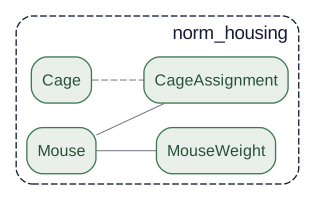
This fully normalized design:
- Intrinsic attributes only —
Mousecontains only attributes determined at creation (birth date, sex) - Cage assignment as event —
CageAssignmenttracks the temporal relationship between mice and cages - Single entity per row — Each mouse is entered once when first tracked
- Later events separate — Cage assignments, weight measurements happen after initial tracking
- History preserved — Can track cage moves over time without data loss
Workflow normalization is stricter than 3NF
The three lenses converge, but they are not equally demanding. A table can
satisfy Codd's normal forms and entity normalization and still violate workflow
normalization. Consider an e-commerce Order that records the whole lifecycle of
an order in a single row:
Order
┌───────────┬────────────┬─────────────┬──────────────┬───────────────┬───────────────┐
│ order_id* │ product_id │ customer_id │ payment_date │ shipment_date │ delivery_date │
├───────────┼────────────┼─────────────┼──────────────┼───────────────┼───────────────┤
│ 1001      │ WIDGET-A   │ C0137       │ 2026-10-16   │ 2026-10-18    │ 2026-10-20    │
│ 1002      │ GADGET-B   │ C0173       │ 2026-10-17   │ NULL          │ NULL          │
│ 1003      │ TOOL-C     │ C3310       │ NULL         │ NULL          │ NULL          │
└───────────┴────────────┴─────────────┴──────────────┴───────────────┴───────────────┘
- Codd: all values are atomic (1NF), the key is not composite (2NF is moot),
and every attribute depends directly on
order_id(3NF). Perfectly normalized. - Chen: every column is a property of the order — payment, shipment, and delivery details all describe this order. Perfectly normalized.
- DataJoint: the attributes are created at four different moments — the order is placed, then paid, then shipped, then delivered. This violates workflow normalization.
The symptoms are visible in the data itself. Order 1003 is all NULLs downstream
because its workflow has not progressed; nothing prevents shipment_date from
being filled before payment_date; and as the order advances, the row must be
UPDATEd again and again. The schema cannot enforce that payment precedes
shipment, because that sequence is not expressed anywhere.
Splitting by workflow step fixes all of this:
@schema
class Order(dj.Manual):
    definition = """
    order_id : int32
    order_date : datetime
    ---
    -> Product
    -> Customer
    """

@schema
class Payment(dj.Manual):
    definition = """
    -> Order                    # can't pay before ordering
    ---
    payment_date : datetime
    payment_method : enum('Credit Card', 'PayPal', 'Bank Transfer')
    amount : decimal(10, 2)
    """

@schema
class Shipment(dj.Manual):
    definition = """
    -> Payment                  # can't ship before payment clears
    ---
    shipment_date : datetime
    carrier : varchar(50)
    tracking_number : varchar(100)
    """

@schema
class Delivery(dj.Manual):
    definition = """
    -> Shipment                 # can't deliver before shipping
    ---
    delivery_date : datetime
    recipient_signature : varchar(100)
    """
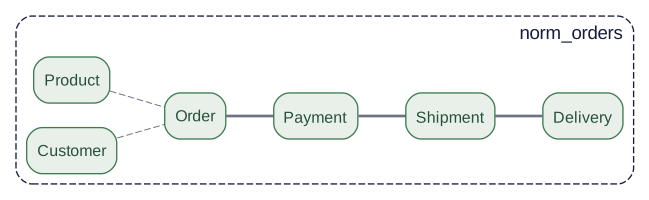
The foreign keys now form a chain — Order → Payment → Shipment → Delivery —
that is simultaneously the referential-integrity structure and the workflow
diagram. Every attribute is non-nullable, because a row exists only once its step
has actually happened. There are no NULLs standing in for "not yet," no updates
as the order advances, and the order of operations is enforced by construction.
As a bonus, workflow state becomes a query: paid-but-not-yet-shipped orders are
simply Payment - Shipment.
Note
This is what "stricter than 3NF" means in practice. Codd and Chen separate data by dependency and by entity type; the workflow lens additionally separates it by when it comes into being. Every workflow-normalized schema is in 3NF, but not every 3NF schema is workflow-normalized.
Updates as a design smell
The e-commerce redesign points to a heuristic that runs through all of DataJoint's schemas:
The UPDATE test
Can your normal, day-to-day operations be expressed purely as INSERT and DELETE?
- Yes → the schema is well normalized.
- No → the schema needs redesign.
In a workflow-normalized schema, intrinsic attributes never change, and anything
that does change over time lives in its own table — usually with a date or
timestamp in the primary key, so a change is recorded as a new row rather than an
overwrite. "Updating" a mouse's weight is an INSERT into MouseWeight;
correcting a step means DELETE the affected row and let the cascade remove
everything derived from it, then recompute. Both preserve history and keep
derived results consistent with their inputs.
Reaching for UPDATE in ordinary operation is a signal that something is
mismodeled — a time-varying attribute was left inside an entity table, or two
workflow steps were merged. DataJoint does provide update1(), but it is a
surgical tool for correcting data-entry errors, and only when nothing downstream
depends on the attribute being changed. The reason is that an in-place edit to an
upstream row silently invalidates every downstream result derived from it: the
foreign keys still match, so the database raises no error, yet the derived rows
now reflect inputs that no longer exist. Deleting instead of updating makes that
dependency explicit — the cascade forces you to recompute what depended on the
corrected value, keeping the pipeline reproducible.
The Workflow Test
Ask these questions to determine table structure:
1. "Is this an intrinsic attribute of the entity?"
An intrinsic attribute is inherent to the entity itself and determined when the entity is first created.
- Intrinsic: Mouse's date of birth, sex, genetic strain
- Not intrinsic: Mouse's cage (assignment that changes), weight (temporal measurement)
If not intrinsic → separate table for the relationship or event
2. "At which workflow step is this attribute determined?"
- If an attribute is determined at a different step, it belongs in a different table
- If an attribute changes over time, it needs its own table with a temporal key
3. "Is this a relationship or event?"
- Relationships (cage assignment, group membership) → association table with temporal keys
- Events (measurements, observations) → separate table with event date/time
- States (approval status, processing stage) → state transition table
Common Patterns
Lookup Tables
Store reference data that doesn't change:
@schema
class Species(dj.Lookup):
    definition = """
    species : varchar(50)
    ---
    common_name : varchar(100)
    """
    contents = [
        ('Mus musculus', 'House mouse'),
        ('Rattus norvegicus', 'Brown rat'),
    ]
Parameter Sets
Store versioned configurations:
@schema
class AnalysisParams(dj.Lookup):
    definition = """
    params_id : int32
    ---
    threshold : float32
    window_size : int32
    """
Temporal Tracking
Track measurements or observations over time:
@schema
class SubjectWeight(dj.Manual):
    definition = """
    -> Subject
    weight_date : date
    ---
    weight : float32   # grams
    """
Temporal Associations
Track relationships or assignments that change over time:
@schema
class GroupAssignment(dj.Manual):
    definition = """
    -> Subject
    assignment_date : date
    ---
    -> ExperimentalGroup
    removal_date=null : date
    """

@schema
class HousingAssignment(dj.Manual):
    definition = """
    -> Animal
    move_date : date
    ---
    -> Cage
    move_reason : varchar(200)
    """
Key pattern: The relationship itself (subject-to-group, animal-to-cage) is not intrinsic to either entity. It's a temporal event that happens during the workflow.
Benefits in DataJoint
-
Natural from workflow thinking — Designing around workflow steps naturally produces normalized schemas
-
Cascade deletes — Normalization + foreign keys enable safe cascade deletes that maintain consistency
-
Join efficiency — Normalized tables with proper keys enable efficient joins through the workflow graph
-
Clear lineage — Each table represents a distinct workflow step, making data lineage clear
Summary
The three lenses at a glance
- Codd (mathematical): depend on the key, the whole key, and nothing but the key.
- Chen (entity): each table is one entity type; every attribute describes it directly, completely, and non-optionally.
- DataJoint (workflow): each table is one workflow step; foreign keys define the order of operations.
All three converge on the same schema. The workflow lens is the strictest, because it also separates data by when it is created.
Core principles:
- Intrinsic attributes only — Each entity contains only properties inherent to itself
- One entity, one entry — Each entity entered once when first tracked
- Events separate — Relationships, assignments, measurements that happen later belong in separate tables
- Workflow steps — Design tables around the workflow step that creates each entity
- Temporal keys — Relationships and observations that change over time need temporal keys (dates, timestamps)
Ask yourself:
- Is this attribute intrinsic to the entity? (No → separate table)
- Does this attribute change over time? (Yes → temporal table)
- Is this a relationship or event? (Yes → association/event table)
Following these principles achieves full workflow entity normalization where each table represents a single, well-defined entity type entered at a specific workflow step.
See also
- Entity Integrity — the uniqueness guarantee that a normalized table's primary key enforces
- Design Primary Keys — choosing the keys that identify each normalized entity
- Model Relationships — connecting normalized entities with foreign keys
- Relational Workflow Model — the broader frame in which normalization, entity integrity, and referential integrity work together